There are many types of vehicle on the road and numerous reasons to have a vehicle examined.
Accidental Damage / Diminution in Value ExaminationThese are perhaps the most commonly requested types of examination. The accidental damage examination clearly deals with such matters as the cost of repairs or pre-accident and salvage values if repair proves not to be a prudent decision. More importantly, it is the opportunity to collect evidence such as the point, magnitude and direction of impact – also to take photographs if required for any future litigation that might result. Any pre-existing defects can be identified at that point.
The diminution in value examination is an opportunity to check on the quality of the repair once the car has been collected and to identify how the vehicle value may have been affected by the nature of any repair and if it can be identified.
Examinations can be carried out on cars, commercial vehicles,
motorcycles and cycles.
.
Mechanical Failure
Mechanical failures are thankfully not
very common nowadays but they still happen. If such a failure is alleged
it is frequently necessary to carry out a degree of dismantling paying particular
attention to preserving any evidence in the process. It is our policy to
be suitably equipped to carry out any necessary dismantling where necessary.
In most cases involving an engine or transmission failure it is possible to get to the root cause of the failure without too much trouble. In some cases parts have to be removed or samples of lubricant or fuel taken and sent away for specialist analysis.
The main thread running through any expert examination is the collection of supportive evidence. This is usually in the form of photographs that, if necessary, are included in the report to illustrate and clarify any points.
If the failure results in loss of control of a vehicle then the matter becomes correspondingly more serious as often injury or death can result.
Forensic Examination
In such a case this type of examination frequently results from criminal proceedings being brought following a serious collision.
In the case of an allegation brought about following a death in a road traffic
collision it is accepted as good practice that the vehicles involved are
examined independently to that carried out by the Police examiners.
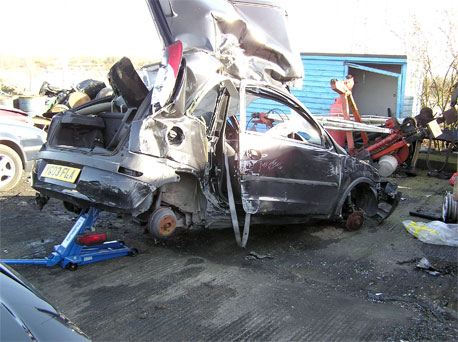 Vehicle being examined at recovery depot following
fatal RTC
Vehicle being examined at recovery depot following
fatal RTC
Unfortunately it is nowadays all too often the case that vehicle examinations carried out on behalf of the Police are not carried out by Police employees themselves and other agencies are used. As such the high standards and understanding of the collision investigator’s requirements cannot be guaranteed. In such a case it is desirable to have a thorough examination carried out independently.
FEA Engineering Consultants carry out expert examinations of such vehicles. In many cases additional information appropriate to the incident has been “brought to the table” as a result of which the Police have had to re-examine the vehicles.
An in-depth examination such as this can establish a whole series of facts, some of which may be relevant to the incident. Such examination is used primarily to establish the existence of any vehicle defects and usually involves the partial dismantling of steering, suspension and brake components. Tyres are carefully examined for defects and evidence of sliding contact. Light bulb filaments are examined for operation and filament distortion.
As with any examination details of any allegations are borne in mind since this allows the investigator to specifically address an area of concern.